TremorSense
Wearable tremor detection and severity classification.
0:00 / 0:00
The work
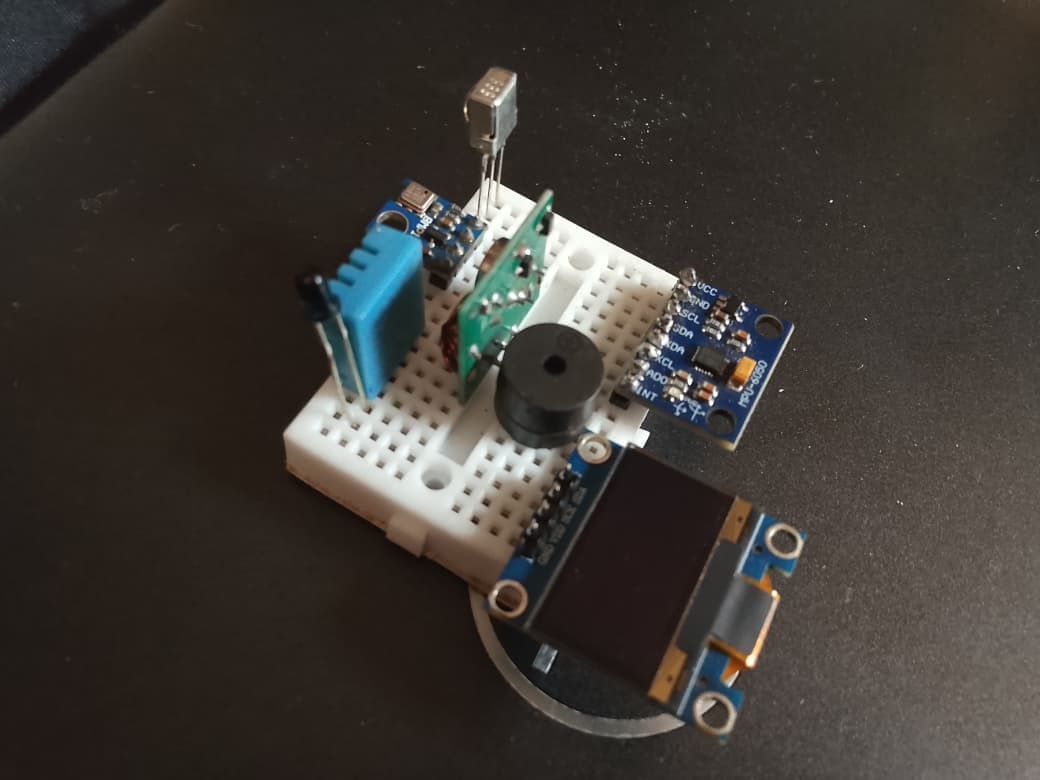
A wearable, IMU-based system paired with an embedded machine learning model for real-time detection and severity classification of Parkinsonian and essential tremor. The current bench build runs entirely on an ESP32-C3, with no cloud connection, and streams a local dashboard of orientation and tremor band metrics.
Development is moving toward a dedicated smart wearable with improved calibration, quaternion based orientation estimation and on-device inference. The signal processing already forms the backbone of the lab's rehabilitation robot work. The near term goal is a low cost, deployable monitoring tool. Longer term it integrates into a rehabilitation robotic arm, extending from passive monitoring to active support for motor recovery after partial stroke.
Bench build
- Microcontroller
- ESP32-C3
- Inertial measurement
- MPU-6050
- Environment
- DHT11
- Readout
- SSD1306 OLED
- Alert
- Piezo buzzer
Session readout
Figures from a single recorded session on the bench build. Not a live feed, and not a clinical measurement.
- Dominant frequency
- 10.16 Hz
- 5 to 12 Hz band
- Research tremor burden
- 6.4 / 100
- Minimal
- Tremor band ratio
- 58.8 %
- Tremor RMS
- 1.0 mg
- Change vs baseline
- -73.3 %
- Signal quality
- 60 %
- Tremor episodes
- 5
- Tremor time
- 28.2 s
0:00 / 0:00
Related papers
- Toward a Personalized Knee Ankle Wearable Exoskeleton for Partial Stroke Rehabilitation: A Review of Design, Control, and Clinical Evidence
Ayelagbe, T.; Osunyemi, P.; Akanbi, G. · IEEE NIGERCON 2026 · 2026
AcceptedPDF